
Quick Commerce in Tier 2 India: Is It Actually Worth It for D2C Brands Yet?
- 4 days ago
- 4 min read
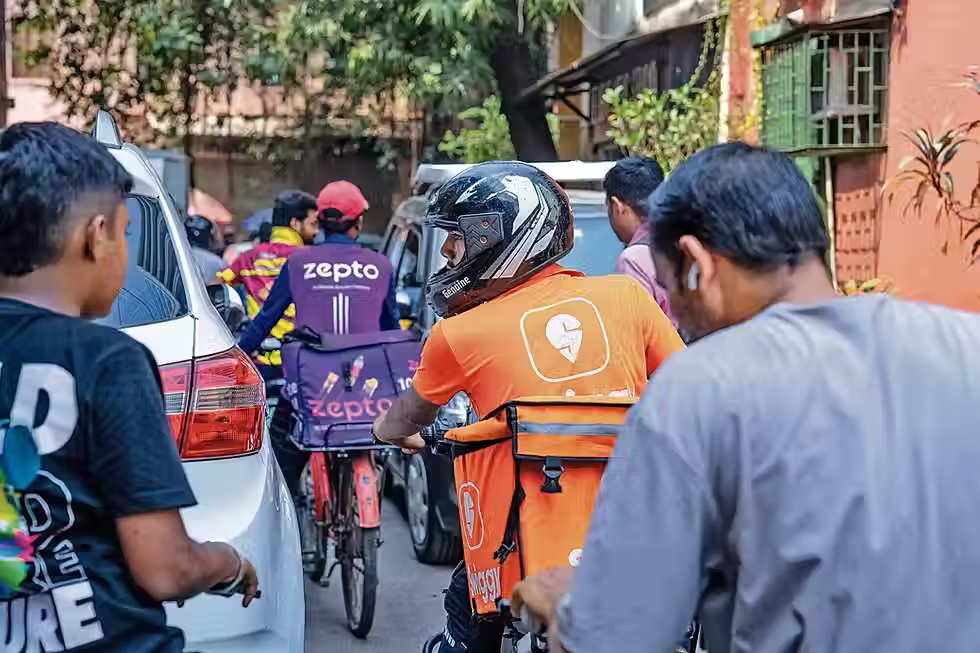
The quick commerce numbers in India are hard to ignore. The sector processed an estimated Rs 11,000 crore in a single month in January 2026, roughly double the year before, on about 7.8 million orders a day according to Redseer. The market is growing at 40 to 45 percent annually and is projected to reach around $12.97 billion by 2029. And the platforms are not slowing down. Bernstein's April 2026 report counts more than 6,000 dark stores operational across India, serving roughly 2,600 pincodes and about 230 million people, which is approximately 17 percent of the country's population.
But most of those 230 million people are still concentrated in metro and Tier 1 cities. The honest version of the quick commerce growth story is that it has been largely an urban, upper-income, high-density phenomenon. The big question for 2026 and beyond is whether the platforms can replicate it in smaller cities, and what that actually means for brands trying to decide where to invest.
Where the expansion stands right now
Flipkart Minutes is the most aggressive mover into Tier 2 and Tier 3 markets. With 1,000 dark stores as of June 2026 and a target of 1,500 by year end, the company is explicitly focused on cities outside metros, already operating in 130 plus cities with names like Rohtak, Muzaffarpur, and Asansol in the mix. Amazon Now is on a similar path, expanding from its initial Delhi and Mumbai coverage toward a national footprint.
Blinkit and Zepto, by contrast, have been more focused on densification within metros rather than geographic expansion, though both are expanding into Tier 1 cities and selectively into Tier 2. Swiggy Instamart has historically been more aggressive on Tier 2 expansion than Blinkit and has used that as one of its competitive differentiators.
The economics of why Tier 2 makes sense for platforms is reasonably clear. A dark store in a Tier 2 city needs around 800 orders per day to break even, compared to 1,300 in a Tier 1 city, according to research from Emkay Global. Lower commercial real estate costs, lower delivery partner wages, and lower competition for that catchment area all improve the unit economics at the store level. The challenge is whether consumer demand is thick enough to reach 800 orders per day quickly enough to justify the capital and operational investment.
The honest read on whether demand is there
Bernstein's May 2026 report put it plainly: Tier 1 to Tier 3 potential is still unproven. The consumer behavior that makes quick commerce work in Bengaluru and Delhi, specifically urban households with disposable income, digital payment comfort, and an impulse-driven shopping pattern, does not map uniformly onto smaller cities. Average order values tend to be lower in Tier 2 markets. The range of products consumers want delivered in 10 minutes skews more heavily toward groceries and essentials, with less of the electronics, beauty, and non-grocery demand that drives higher margins.
This does not mean the opportunity is not there. It means the platforms are still in the process of discovering what quick commerce looks like in these markets, and the brand playbook in Tier 2 is likely to be different from the metro playbook.
What does seem to be consistent across geographies is that platforms are finding willing delivery partners and available commercial space. What is less proven is whether the consumer is ordering at the frequency and basket size that makes the model work at the store level. The data over the next 12 to 18 months will settle this question more definitively than anything currently available.
What this means for brands making distribution decisions
For FMCG brands in daily essentials, packaged foods, and staples, Tier 2 expansion on quick commerce creates a genuinely new distribution opportunity. The challenge in general trade in smaller cities has always been shelf visibility, supply chain discipline, and the difficulty of reaching smaller kirana outlets consistently. A dark store model bypasses a lot of that complexity and puts a brand directly in front of consumers who have already moved to digital ordering.
For premium, higher-consideration, or niche D2C brands, the calculus is different. Quick commerce in Tier 2 is likely to remain grocery and essentials heavy for the next year or two, which means the organic visibility and consumer intent for premium categories will be lower than in metro markets. The investment in getting listed and managing supply to new geographies may not pay off at the same rate.
The practical decision for most brands right now is probably not to actively pursue Tier 2 quick commerce but to build the supply chain and operational discipline to respond quickly when the platform demand signals arrive. The brands that will benefit most from Tier 2 expansion are the ones that can fulfill a purchase order for a new city within a week, not the ones that need three months of planning to extend their dark store coverage.
The one thing that cuts both ways
The Tier 2 expansion also changes the brand-building dynamic of quick commerce in an interesting way. Part of the value of being on Blinkit in Bengaluru or Zepto in Mumbai is the density of urban consumers who see your product, try it, and potentially become repeat buyers across multiple channels. In Tier 2 cities, that trial-driven brand building opportunity is actually significant, particularly for brands trying to reach consumers who are not on Amazon or D2C websites.
That aspect of the Tier 2 opportunity is probably undervalued in most brand team conversations right now. If a consumer in Dehradun or Jaipur tries your product because it appeared on Blinkit and liked it, the repeat purchase and word-of-mouth in that market is valuable beyond what the platform GMV number suggests.
RevQ tracks pincode-level availability and share of voice across quick commerce platforms including Blinkit, Zepto, Swiggy Instamart, and Flipkart Minutes, helping D2C brands understand where their distribution is active and where the gaps are as the platforms expand into new cities.

